
Back-End Architecture for Growing Applications: What Should You Plan for Early?
October 18, 2026A back end of a system that works well when a product is still in its infancy may become a hurdle when the application gets more users, integrates new systems, handles more data, and adds new features.
However, a key objective of early architecture planning is not to create a back end that will easily accommodate substantial future growth. Rather, it is to develop a set of building blocks that can grow over time without requiring the entire system to be overhauled down the road.
Let’s look at the key things to consider during early design.
Begin With a Modular Structure
Scalability doesn’t necessarily imply microservices architecture.
Although microservices suit many growing applications, a modular monolith may prove to be a better starting choice since this architecture ensures smooth deployment while keeping functions separated into distinct domains such as:
- User administration
- Payment processing
- Order management
- Notifications
- Reporting
A well-defined architecture allows to keep the system easier to maintain and enable the separation of components into distinct services in the future without the unnecessary complexity of distributed systems.
Read: What AI Agents mean for Engineers: Alexey Tulia on Ownership, Safeguards and Technical Judgment
Design APIs for Future Growth
APIs should be designed for growth. While an API might be used solely for a web application at first, it can develop into supporting mobile applications, partner platforms, dashboards, or third-party integrations.
Teams should put in place API principles in the beginning such as:
- Versioning
- Consistency in error responses
- Pagination
- Rate limiting
- Idempotency for important operations
The use of stable API contracts helps mitigate the risk of interfering with other systems’ functionality when the products evolve.
Take the Time to Make the Right Design Decisions
Database-related decisions can be much harder to alter than programming but can have a great impact on how easily you will be able to change.
You need to think through the data model considering the future required features of the application like multiple organizations, different locations, currencies, subscription plans, types of users, etc.
While precise modeling of every possible future situation is not needed, it is important to avoid overengineering since this would greatly ease the transition.
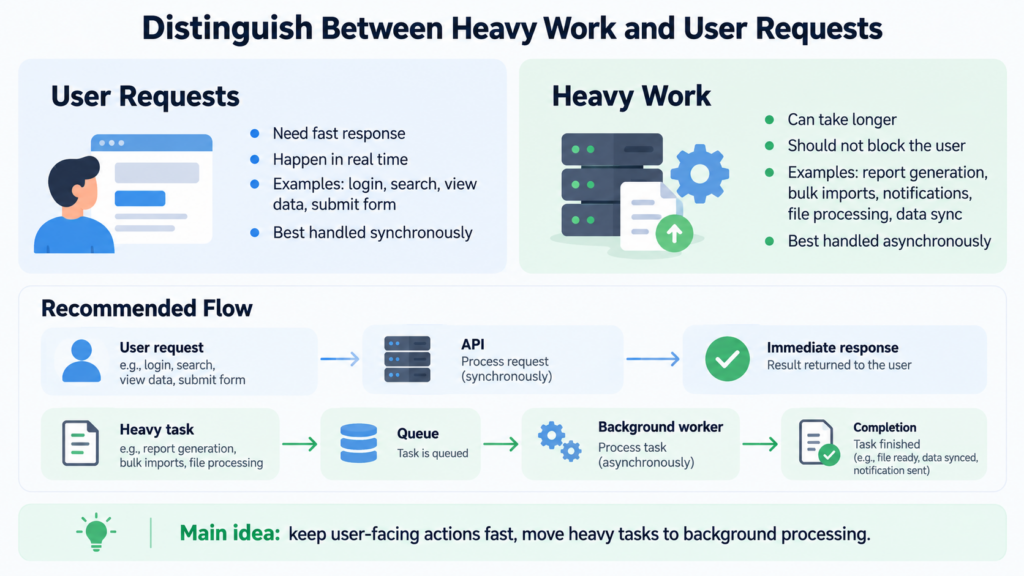
Distinguish Between Heavy Work and User Requests
Not every task must be performed during an API request.
Report generation, bulk imports, notifications, file processing, and syncing with an external data source are often conducted asynchronously.
The use of message queues and background workers allows us to perform this type of task separately without negatively influencing the response time of our request and scalability.
Prepare for Horizontal Scaling
Frequently growing applications use horizontal scaling instead of depending on a single stronger server.
To facilitate this approach, back-end services need to be as stateless as possible.
Sharing data such as sessions, files, and application states with the help of dedicated systems is a good option in this case.
The use of load balancers in this way can also help us distribute load through multiple instances and improve the resilience of the system.
Introduce Caching Strategically
In busy times when incoming traffic is high, continuously receiving the same data from the main database could lead to extra strain.
The use of caching is appropriate when dealing with data like:
– Product catalogs
– Configuration parameters
– Sessions
– API calls
– Search outputs
Even so, it would be a good idea to clearly outline the rules regarding cache deletion and termination. If the caching object is not managed properly, it may lead to unsolvable consistency problems.
Isolate Third-Party Integrations
Various external services may fail, get stuck, modify their APIs, or increase their limits.
Thus, payment processing, CRM system integration, logistics, and any other services should be kept separate from business logic.
Creating a separation layer will enable one to introduce retry operations, monitoring, fallback reactions, and switching the providers without interfering with any other process.
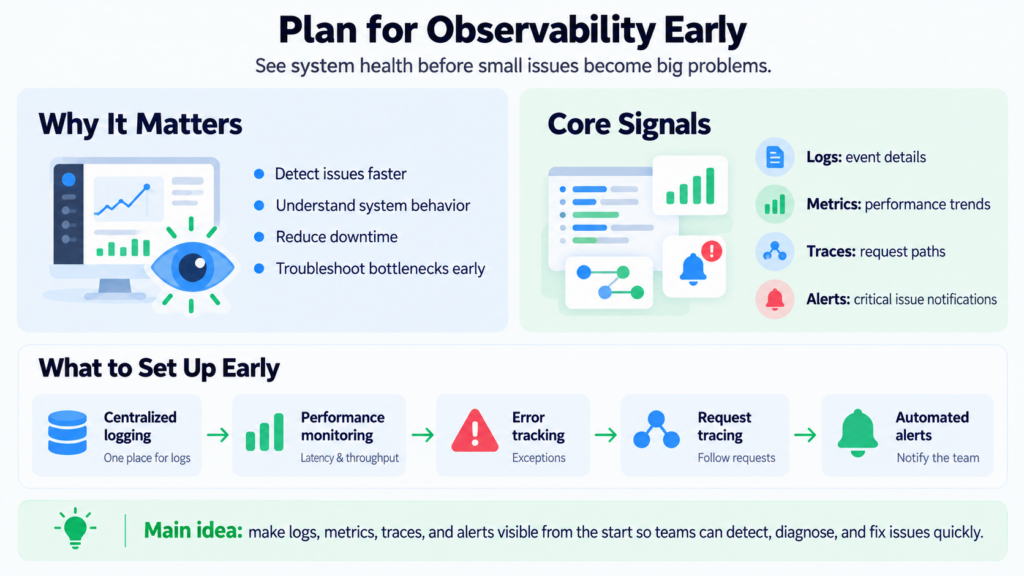
Plan for Observability Early
It is easier to address scaling issues when teams can monitor the inside workings of the system.
Back-end systems should allow for:
- Centralized logging
- Performance monitoring
- Error tracking
- Database monitoring
- Request tracing
- Warnings for critical errors
There are notable advantages of observability in that it allows teams to identify bottlenecks before they lead to serious issues in production.
Security Needs To Be Part of Architecture
Integrating security in the system is substantially simpler at the outset than trying to make changes later.
Key points include authentication, role access management, encryption, secrets administration, audit/logs, API security, and the overall safe management of information.
Applications working in regulated sectors may also be required to comply with different regulations like GDPR, HIPAA, PCI DSS, etc.
Avoid Overengineering Right Away
One of the most common errors in architectural design is creating infrastructure for uncertain dimensions.
A new company doesn’t require a host of microservices, numerous databases, and elaborate event-based architecture to find its niche on the market.
This, in turn, dictates that a more reasonable decision is to design a simple architecture, with clear limits in place, and modify it only when necessary requirements occur.
The key goal is not to achieve maximum intricacy but to provide for controlled evolution.
Final Thoughts
A proper back-end architecture allows a system to evolve as needed without introducing unnecessary complexity at the early stages of development. When planning back end development services, project teams should focus on modularity and API composition from the outset, along with data modeling, asynchronous operations, horizontal scalability, caching, third-party integrations, observability, and security. If these fundamentals are carefully planned, scaling can remain relatively simple and cost-effective instead of turning into a complex rework process.